
9 Broadway St East
Lloyd Wise
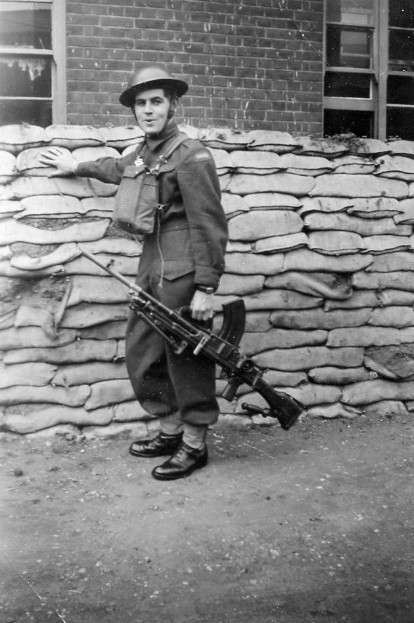
Lloyd Wise was born on November 2, 1920. When the Second World War broke out, Lloyd was living at 9 East Broadway Street. The house no longer exists. It was located at what is now the north end of the Paris Central School.
Lloyd enlisted with the 69th Field Battery, a sub-unit of the Canadian Army Reserve's 56th Field Artillery Regiment. It was mobilized in May 1940 in Brantford and Lloyd enlisted on May 6, 1940, so he would have been among the first to enlist. He almost was not accepted. The first time he tried to enlist he couldn't pass the eye test. He tried again after he had memorized the eye chart and this time he was accepted. He, like many other Paris boys, thought that it would be a great adventure. He said later that "they had no idea what they were getting into."
The Regiment departed Canada in July 1941 and many of its personnel, alongside men from other local batteries, were later transferred to the 12th Field Regiment, Royal Canadian Artillery, with whom they saw action on the continent after D-Day. At some point during the war, Lloyd transferred to the Queen’s Own Rifles, but it is unclear with which regiment he went overseas.
Lloyd spent the war in England and later in Northwestern Europe, fighting in France and Holland. He was in England when he met his future wife at a church dance in Sussex. Peggy Wise remembered that it was raining that night, and she looked up to see a group of Canadian soldiers arriving. One of them looked very dashing in his rain cape. That was Lloyd. The relationship grew and they decided to get married, but Lloyd had to join his outfit in France.
Lloyd was with his unit, probably with 7th platoon Able Company, in the Queens Own Rifles, on D-Day. D-Day was the most pivotal battle of the Second World War. On June 6, 1944, the Canadian Army played a significant role in the Allied invasion of Normandy, France, specifically landing on Juno Beach. The 3rd Canadian Infantry Division and the 2nd Canadian Armoured Brigade were the main forces involved, with the Royal Canadian Navy and Royal Canadian Air Force providing crucial support. While the Canadians achieved their initial objectives, the landing was not without significant cost. Over 340 Canadian soldiers were killed, 574 were wounded, and 49 were captured on D-Day. The Canadian forces continued to fight in Normandy, pushing inland and playing a crucial role in the liberation of France and the Netherlands. The Canadian contribution on D-Day was vital to the success of the invasion and marked a significant moment in the liberation of Western Europe. But what Lloyd told his family about D-Day was bobbing around in the English Channel for days. He was a left gunner, and his 25-pounder gun was too heavy to carry in the first wave. He had to deal with sea sickness and uncertainty while he waited to land.
The Allies continued to push through France and the Netherlands after D-Day, but Lloyd and Peggy wanted to get married. So Lloyd informed his superiors that he wanted to take training in how to use a Bren gun. That training required him to return to England, so Peggy and Lloyd used the leave to move up their wedding plans. (It may also have contributed to the birth of their eldest son, Douglas, who was born in England.) Fabric was rationed in England, but Peggy's relatives donated their clothing ration coupons for her wedding dress. Peggy and Lloyd married in October, 1944. Six months later she received a telegram that he was missing in action, presumed dead.
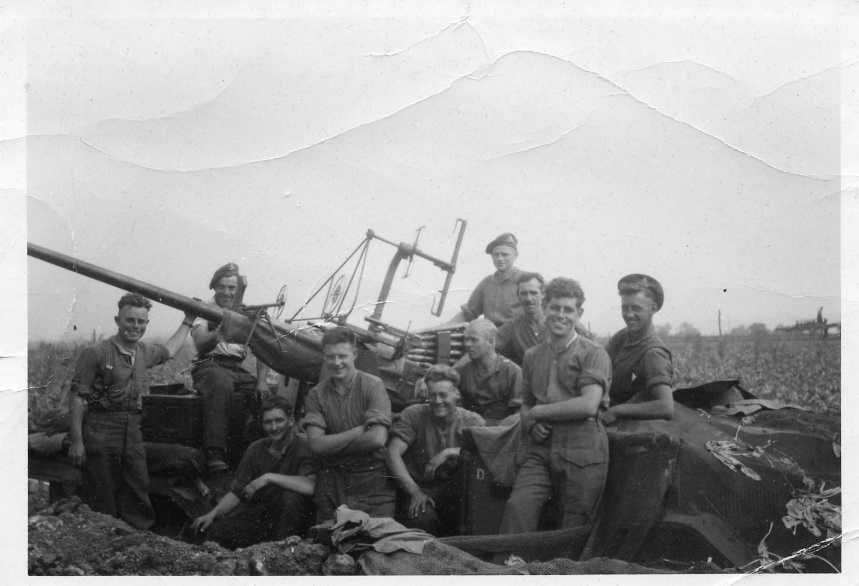
Lloyd had fought his way through France, survived D-Day, and then was part of the Allied effort to liberate Holland. (Lloyd is second from the right.) After spending almost four years in the army, his luck finally ran out. He was wounded by shrapnel from a grenade and was captured. Things were chaotic and he and a 17-year-old Canadian soldier from Toronto were in a barn under fire and were taken prisoner. They managed to escape and separated. Lloyd found himself at a German checkpoint when trying to cross a canal on a bicycle. At first the German soldiers took him for a spy and were going to shoot him, but Lloyd convinced them he was an escaped prisoner and Lloyd was sent to a prison camp. He was liberated on May 7, 1945, and he could finally reassure Peggy that he was in fact still alive. POWs were returned home first, so he was back in Canada in August. He was proud of his service, but like many veterans, rarely spoke about it, except for bobbing in the Atlantic on D-Day, or getting married, or getting captured twice.
Back in Paris with a wife and child, Lloyd had to find work. He found a low paying job in the Post Office first, then worked at Penmans repairing machines. Next, he worked as a molder at Cockshutt Industry, pouring molten iron metal into molds. That experience took him back to Paris, where he worked with Ross Mitchell, installing furnaces and heating ducts. Lloyd decided quickly that he could do this business himself and Lloyd Wise Sheet Metal was born. The company name changed when his son, Mike Wise, took over the business. Wise Heating and Air Conditioning is still in business.
Lloyd always enjoyed the outdoors, camping and fishing in and around Algonquin Park. He often went north when he had the opportunity and decided that he should move there permanently, to a cottage he built himself near Sundridge and the Park. He bought a fire-engine red Miata in his 80’s, then convinced his son Mike to buy a newer one himself. Then Lloyd decided he should have that one instead.
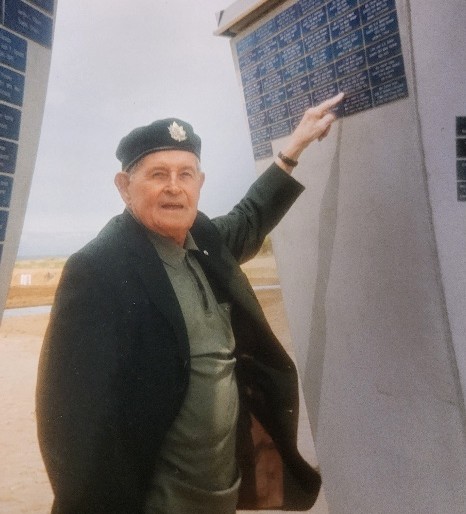
Living on his own, Lloyd was beginning to fail physically, so he decided to come back to Paris, to Telfer Place, for a one-month trial. One month later, after some rest and regular nutrition, Lloyd was seen outside Telfer Place loading his belongings into a friend’s pickup truck. Lloyd was going back north. However, not long after, Mike and Susan, Lloyd’s daughter, got a call from the Powassan Nursing Home. Lloyd’s health was failing again. He died on July 10, 2010, just months before his 90th birthday. Lloyd’s ashes were taken to sites on North Tea Lake, on the west end of Algonquin Park, a place he loved all his life and shared with his family.