
52 Silver Street
Private Reginald "Reg" Alfred Robbins
Reg Robbins was born 9 October 1914, and raised in Brantford. He was the son of William and Josephine Robbins. He was the sixth child in a family of 14: he had six brothers and five sisters. He attended school in Brantford until Grade 7. After that, he worked in several jobs. He worked 10 months in a toy factory and after being unemployed for two and a half years, worked for five years making fast food at a lunch stand. He spent one year at Penmans as a chore boy and two months in a screen door and furniture factory. In the 14 months before he enlisted, he was a card stripper at Wincey Mills in Paris.
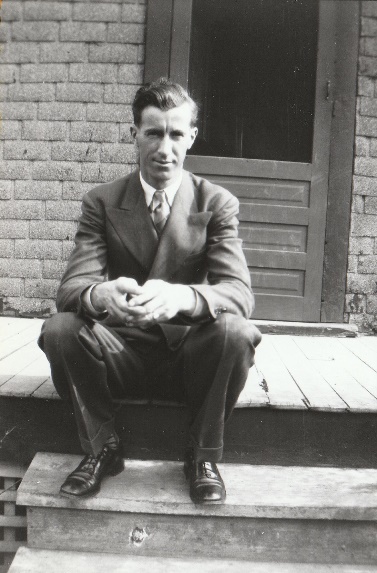
By this time, he had married (Ethel) Jean Hynds of Paris, in February, 1940, and they were living at 52 Silver Street in Paris. Reg served with the Dufferin and Haldimand Rifle Battalion (Reserve) as a Private from July 1940 to May 1941. After training at Camp Borden with the Queen’s Own Rifles, Reg signed up and went overseas where he joined the North Nova Scotian Highlanders, who had suffered serious personnel losses in battle. He reached France on July 28, 1944, shortly after the D-Day invasion in June. While the Canadians and Allied forces achieved their initial objectives, the war was far from over. The Canadian forces continued to fight in Normandy, against fierce and desperate German defences, pushing inland and playing a crucial role in the liberation of France, Belgium and the Netherlands. Reg was wounded in September near Calais, while liberating the belt of small ports along the Normandy coast. He spent two months convalescing in England before returning to his regiment in early December, 1944.

Reg sent a letter home to his wife Jean at Christmas, 1944. In it, he asked his wife to send some soap. He was stationed in farmhouse in a small unnamed town and met a Dutch woman washing her clothes with a scrub board and water from a stream. She said they were not allowed such luxuries as soap. He told Jean that providing her with soap was the least they could do. In another letter, he told Jean of seeing a pair of little feet under his bed where Reg had stored a package of chocolates she had sent. Reg gave the young Dutch boy all the chocolate. In January, 1945, he received a letter informing him of the birth of his own son, Reginald Wayne Robbins, who was born on January 2.
In the lead-up to the Allied invasion of Germany, the North Nova Scotia Highlanders, as part of the 3rd Canadian Infantry Division, engaged in fierce fighting to cross the Rhine and advance into Germany. The operation, called Operation Veritable, did not start well for the Highlanders. The ground was flooded and impassable to mechanized vehicles, and as a result, troops had to be moved by Buffaloes, special armoured amphibious vehicles that could move through mud and water. The poor terrain and a lack of amphibious vehicles caused delays which were further complicated by nightfall. on February 14, The North Nova Scotia Regiment crossed the River Rhine in their Buffaloes with very little opposition and few casualties. Firm on the East bank of the River Rhine, the regiment took up positions in buildings at Emmerich. The Germans did not choose to counterattack, as the ground conditions were appalling, opting instead to shell B Company’s position, which was quickly silenced by Canadian artillery counter-battery fire. The challenging ground conditions continued with rising water made the North Nova Scotia Regiment’s position untenable. It took them three days to extricate themselves due to insufficient Buffalo support.
On February 20, the Highlanders were ordered to retake the initiative and were reinforced with three infantry companies, a half squadron of tanks, and several anti-tank guns, to give them overwhelming strength to defeat the enemy. At 1130 AM on 22 February they attacked after a thirty-minute delay to wait for coordinated tactical air support and managed to achieve their objectives despite heavy German artillery bombardments. Reg was one of nine Highlanders who were killed during this operation. He was buried temporarily in Bedburg, Germany, which is just west of Cologne, but his body was later removed to the Groesbeek Canadian Military Cemetery in Nijmegan, Holland. He left behind his wife Jean and a son, Reginald Wayne, who he never got to see. In 1998, Jean made a trip to the Netherlands , along with her son Wayne and two grandsons, Reggie and Tim, to visit Reg’s gravesite and to place a wreath on the war monument in his honor.
(This information was taken in part from the Canadian Virtual War Memorial created by Veterans Affairs Canada)